
Moving With Plants Across State Lines: Rules, Risks and What Movers Allow
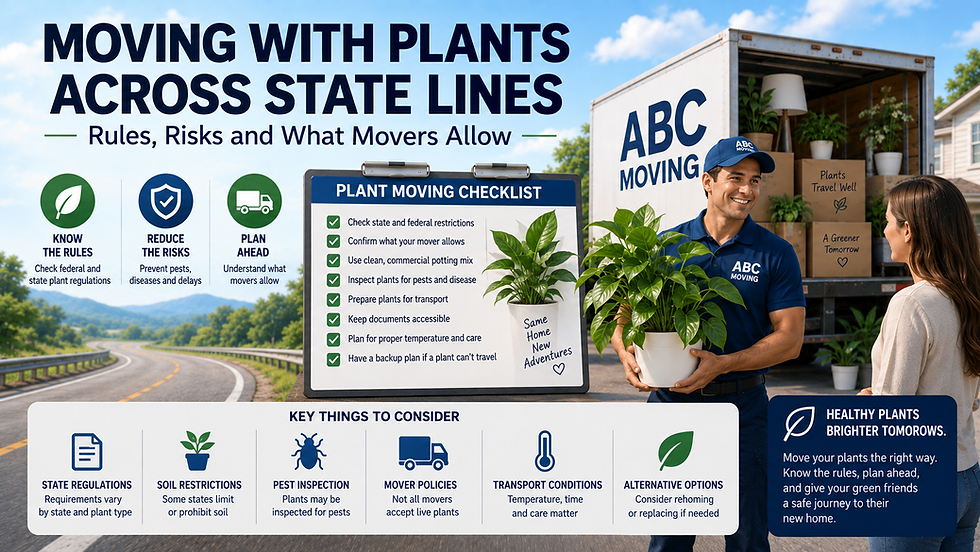
Your furniture can wait in storage. Your houseplants need a different plan.
A plant that has followed you through several homes may be worth far more to you than its replacement price. But before putting it in the car—or asking the moving crew to load it—you need to answer three separate questions:
Is the plant allowed to enter the destination state? Will your chosen carrier accept it? Can it survive the transportation conditions?
A “yes” to one does not answer the others.
Moving With Plants Across State Lines can be possible, but the requirements depend on the plant, its growing medium, where it has been kept, and the places it is traveling from and to. Federal and state plant-health authorities regulate certain movements to prevent the spread of insects, diseases, and invasive plants. The National Plant Board’s state regulation directory is a useful starting point for finding the applicable state requirements.
This guide focuses on personal household plants moving between the contiguous U.S. states. It explains how to check restrictions, coordinate with your mover, choose transportation, and prepare the plants that are permitted to travel.
Moving With Plants Across State Lines: Three Checks Before You Pack
Treat plant relocation as a separate part of your moving plan.
Check | What you need to establish | Who can confirm it |
Legal eligibility | Whether the species, soil, origin, and destination meet applicable requirements | State agriculture authorities and USDA APHIS |
Transportation acceptance | Whether live plants are included in the service you purchased | The actual transporting carrier |
Plant care | Whether the plant can tolerate the route, temperatures, handling, and time without normal care | You, with species-specific horticultural guidance when needed |
For example, a plant might qualify for entry into a state but still be excluded from your mover’s service. Alternatively, a carrier might be willing to transport a plant that cannot legally leave its quarantine area.
Do not use a moving-company approval as a substitute for plant-health clearance.
The same applies to personal transportation. Putting a plant in your own car does not remove agricultural restrictions. California’s guidance, for example, expressly addresses both commercial movers and private individuals bringing houseplants into the state.
Why States Regulate Plants and Soil
A healthy-looking plant is not necessarily pest-free.
Insects, eggs, pathogens, and other organisms can travel on foliage, stems, roots, pots, and growing media. USDA APHIS warns that even plants without obvious symptoms can carry pests or diseases to a new location. Its guidance on moving plants and soil recommends checking plants carefully and considering rehoming them rather than moving them long distances.
That is why “I have owned it for years” is not enough to establish that a plant can travel.
A quarantine is a restriction intended to prevent a pest or disease from spreading. Depending on the applicable rule, it can affect an entire state, a smaller area, particular plant species, soil, or other materials.
The useful question is not simply:
Can I move plants to Florida?
It is:
Can I move these particular plants, grown under these conditions, from this location to that Florida address?
Make a Plant List Before Contacting Anyone
Start with a simple record of the plants you want to take.
Include the common name and botanical name when known, quantity, approximate size, pot type, growing medium, and whether the plant has lived indoors, outdoors, or both. Add your origin address, destination address, planned travel date, and transportation method.
Photographs are useful, especially when a plant’s identity is uncertain.
Be honest about outdoor exposure. A plant that spends summer on the patio should not automatically be described as “indoor-only.”
Keep the plant list separate from your furniture inventory. Then mark each plant as:
Pending review: Entry requirements or carrier acceptance are not yet confirmed.
Approved for the planned arrangement: Required conditions and transportation have been confirmed.
Not traveling: Rehoming, replacement, or another lawful arrangement is needed.
This makes it harder for an undecided plant to end up on the truck by accident.
Do You Need an Inspection Certificate or Permit?
Not every personal houseplant movement requires the same paperwork.
Depending on the state, species, origin, and quarantine status, you may need an inspection certificate, a permit, another official plant-health document, or no certificate under a specific household-plant exemption.
A certificate is not an automatic exception to a prohibition. Ask which document is required and whether the plant is eligible for certification in the first place.
The state examples below show why there is no reliable one-document answer for every interstate move. Review the official guidance, then contact the destination state’s plant regulatory office with your plant list. Ask the origin state how to obtain any required inspection or certification.
Also ask whether your route creates transit requirements. Do not assume that the destination is the only jurisdiction that matters.
A receipt from a garden center may help establish where a plant came from, but do not assume it replaces an official certificate.
State Examples: California, Florida, Arizona and Texas
These examples explain how requirements differ. They are not a complete clearance checklist for every plant or route.
Bringing houseplants into California
California’s published houseplant guidance describes eligible personal houseplants as ornamental plants grown indoors in sterile, packaged commercial potting mix—not plants maintained outdoors or grown in backyard soil.
Plants remain subject to inspection and pest-related rejection. CDFA also directs private travelers to declare their plants and keep them accessible. Commercial movers are instructed to identify houseplants on the shipment inventory and position them for inspection.
Check CDFA’s houseplant entry guidance, and obtain separate advice for citrus, trees, or other regulated plants.
Moving an outdoor plant indoors shortly before departure does not establish that it meets an indoor-only requirement.
Bringing personal plants into Florida
Florida’s guidance says noncommercial homeowner plants traveling as baggage or household effects may enter with a certificate of inspection.
It also describes an alternative when the origin state does not offer inspection and certification for houseplants: the owner must provide a Florida address where the plants will be located, allowing follow-up inspection when necessary.
This is not a general permission to skip certification whenever obtaining it is inconvenient. Species-specific restrictions still need to be checked.
Review the Florida Department of Agriculture and Consumer Services’ plant import requirements before arranging transportation.
Bringing houseplants into Arizona
Arizona allows qualifying indoor houseplants for personal use without an origin-state certificate when they are pest-free and planted in clean, commercially prepared potting mix.
Outdoor plants and other plant material follow different requirements. Quarantine conditions can add further restrictions.
Use the Arizona Department of Agriculture’s interstate plant-moving guidance, and do not assume the personal-houseplant provision covers patio plants, nursery stock, or plants from regulated areas.
Moving citrus into or within Texas
Texas specifically prohibits unauthorized movement of citrus, related plants, and other quarantined articles into the state. It also restricts certain citrus movements within Texas.
A potted lemon tree should therefore not be treated like an ordinary decorative houseplant simply because it is small.
Check the Texas Department of Agriculture’s citrus information and obtain guidance for the exact plant and route before moving it.
Soil Can Change Whether a Plant Is Allowed
A plant and the material around its roots need to be considered together.
USDA APHIS restricts movement of domestic soil from certain quarantined areas. The applicable conditions depend on the pest, location, and purpose of movement; some movements may be authorized through specific arrangements. This is not the same as a blanket rule that all soil is prohibited between every pair of states. See USDA APHIS guidance on domestic soil.
Before packing, ask about garden soil, compost, soil attached to roots, and growing media in outdoor containers.
Commercial potting mix may satisfy part of a state’s requirements, but repotting does not automatically clear the plant itself. Its species, origin, pest status, and outdoor history can still matter.
Do not remove soil, apply a treatment, or switch containers on the assumption that you have created a legal exemption. Confirm the required preparation with the relevant authority.
Citrus Trees and Cuttings Need Special Attention
Citrus deserves its own review.
USDA APHIS advises people not to transport or mail home-grown citrus plants out of citrus-greening quarantine areas. Its guidance also addresses branches and other regulated material. Commercial nursery movement follows specific protocols that should not be assumed to apply to a homeowner’s tree.
Check USDA APHIS citrus greening and Asian citrus psyllid guidance before planning to move a citrus plant.
A cutting is not automatically a loophole
Taking a small cutting may solve a space problem, but it does not necessarily solve a regulatory problem.
Plant rules can cover propagative material as well as whole plants. Florida’s definition of nursery stock, for example, includes cuttings, grafts, scions, and buds.
Ask about the exact material you intend to take—whole plant, rooted cutting, unrooted cutting, bulb, or seed—rather than assuming all forms receive the same treatment.
Check Outdoor Pots and Garden Equipment Too
The pest risk does not end when a plant is removed from its pot.
USDA APHIS provides a moving-related inspection process for outdoor household articles leaving spongy moth quarantine areas for non-quarantine areas. Its instructions include inspecting items, completing the appropriate checklist, and keeping the record with the shipment.
Review the APHIS spongy moth moving instructions, particularly when moving outdoor furniture, garden equipment, or items kept near plants.
Imported fire ant restrictions can also affect regulated plants, soil, and related articles leaving quarantine areas. APHIS provides current maps and certification information through its imported fire ant program.
Before loading empty planters or garden equipment, check for soil residue and pests. Cleaning is useful preparation, but it does not replace a required inspection or certificate.
Will an Interstate Moving Company Transport Live Plants?
Do not assume live plants are included in “full-service moving.”
Ask the actual transporting carrier for a written answer covering your specific shipment. Establish whether it accepts live plants, limits acceptance to certain conditions, or will transport only empty pots and related equipment.
Then ask what acceptance means in practice:
Transportation conditions: Will the plant be in a temperature-controlled space? Can it enter a warehouse? Could the shipment be transferred between vehicles?
Care and access: Will anyone provide water or other care? Can the plant remain accessible for an inspection? What happens if delivery is delayed?
Documents and responsibility: How will the plant appear on the inventory? What exclusions apply? Who handles a rejected plant?
A driver saying “we can squeeze it in” does not resolve these questions.
If a broker arranged the move, obtain the carrier’s answer rather than relying only on the salesperson’s assurance.
Live plants are only one category of belongings that a moving company may restrict or refuse. Carriers can also have policies covering hazardous materials, perishables, valuables, firearms, chemicals, food, and other items that may create safety, liability, or transportation problems. Checking these exclusions before packing helps prevent last-minute surprises at pickup. For a broader breakdown, read:
Dedicated or Expedited Service Does Not Automatically Solve the Problem
Paying for a dedicated truck or faster delivery is not the same as arranging live-plant care.
Before buying a premium service for your plants, ask what it actually changes. Does it shorten the time in transit? Provide temperature control? Prevent warehouse storage? Allow access for inspection? Include care during a delay?
If those details are not part of the agreement, do not assume they are included.
The same distinction applies to “climate-controlled storage.” Ask about light, watering, access, and permission to store live plants—not temperature alone.
For planning purposes, treat the furniture delivery schedule and the plant-care schedule as separate commitments.
Choosing How to Transport Your Plants
Once the legal requirements are clear, compare the practical options.
Personal vehicle
For plants that are permitted to travel and fit safely, personal transportation lets you control the route, stops, temperature, and access.
Plan space in the passenger cabin or another appropriately temperature-controlled area. Keep containers secure and out of the driver’s view, controls, and airbag zones.
Do not plan to leave plants in an unconditioned parked vehicle during hot or freezing weather. Stable conditions matter: University of Illinois Extension’s houseplant care guidance advises avoiding extreme temperature changes and direct blasts of hot or cold air.
A specialist or separate shipment
For a large collection or difficult specimen, ask a specialist to provide a written plan addressing acceptance, packing, plant-health paperwork, temperature, timing, care, and liability.
Do not assume that advertising “plant transport” proves the provider can handle your species or interstate route.
Parcel shipping
Mailing a plant does not bypass agricultural rules.
USPS states that plant material prohibited from shipment out of a quarantine area is nonmailable. Other regulated movements may require inspection and official documentation.
Check USPS plant quarantine rules before mailing a plant or cutting, and arrange for someone to receive it promptly.
Rehoming or replacing plants
Keeping every plant is not always the best outcome.
For healthy plants that can lawfully be transferred locally, consider a friend, neighbor, or plant group. Do not pass along a plant with a suspected regulated pest without obtaining instructions.
For inexpensive plants, replacement may cost less than arranging special transportation. For a sentimental specimen, a permitted cutting may be an alternative—but check the rules first.
How to Prepare Plants That Are Allowed to Travel
Prepare for the plant you have, not a generic “houseplant.”
Inspect before packing
Check leaves, stems, pot rims, drainage holes, and visible growing media. Look for insects, egg masses, webbing, unusual discoloration, or other signs of a problem.
Do not move a visibly infested plant into the packing area with healthy plants. Ask an extension service or plant-health authority for help when needed.
Iowa State University Extension’s guidance on bringing plants indoors explains why inspection and separation help prevent hitchhiking pests from spreading.
Stabilize the container
Use a sturdy tray, crate, or box that supports the pot. Fill gaps around containers so they cannot slide or tip, while leaving foliage enough room.
Lift by the container—not the stem.
For fragile decorative planters, consider whether the plant can travel in a suitable inner pot while the decorative container is packed separately. Avoid unnecessary last-minute repotting merely to make packing easier.
Water according to actual need
Do not follow a universal rule to soak every plant before departure or stop watering every plant for several days.
Check the growing medium and the species’ normal requirements. Let excess water drain before loading, and prevent containers from sitting in collected water. Illinois Extension specifically cautions against allowing pots to stand directly in water.
Label without concealing
Identify the container as containing a live plant and keep required paperwork accessible.
Do not disguise plants as ordinary household cartons. A label helps handling, but it does not replace official documentation or carrier approval.
Plan Overnight Stops Before You Leave
A plant-care plan should cover the entire trip, not just driving hours.
Before departure, decide where plants will stay during meals, hotel stops, delays, and the period before you can enter the new home.
Check that your overnight accommodation permits the plants and that you can move them indoors without creating an unsafe carrying task.
Avoid packing arrangements that require unloading half the vehicle to reach a plant needing attention.
For plants with particular temperature or light requirements, ask a horticultural professional what conditions are appropriate for that species. Do not assume all succulents, orchids, tropical plants, or young cuttings tolerate the same trip.
What Happens at an Agricultural Inspection Station?
Follow posted instructions and declare plants when required. Keep the plant list and applicable certificates available rather than buried beneath furniture.
California expressly instructs private travelers to declare houseplants and keep them accessible. It also warns that inspectors can reject plant material presenting a pest or disease risk.
An inspector may need to examine the plant or its growing medium.
If a plant cannot continue, ask the official what disposition is permitted. Do not abandon it, dump soil beside the road, or look for a route around the inspection.
Build time for inspection into your travel plan. An appointment at the new home does not override an agricultural requirement.
What Does Moving Plants Cost?
There is no useful universal price for moving a plant collection.
Compare the costs that apply to your arrangement: inspection or certification, suitable containers, protective packing, specialist transportation, extra vehicle space, overnight handling, and temporary care.
Also consider replacement value and personal significance.
A practical comparison is:
Total transportation and care cost versus replacement cost, adjusted for how important the original plant is to you.
Do not use sentimental value as a reason to skip legal requirements. It is a reason to plan earlier and choose a suitable lawful option.
When a provider quotes a plant-moving charge, ask whether it includes paperwork coordination, packing, waiting, special handling, and care during delays.
Are Plants Covered if They Are Damaged During the Move?
Do not assume that a plant accepted for transportation has the same protection you expect for furniture.
Ask the carrier or insurer to explain the treatment of the living plant, its container, and any loss caused by temperature, delay, lack of care, breakage, or mishandling.
A cracked ceramic planter and a plant that declines after several days without suitable conditions raise different questions.
FMCSA warns that including perishable materials in household goods without the mover’s knowledge can limit or reduce the mover’s normal liability. That is another reason to disclose plants rather than hide them inside owner-packed cartons. See FMCSA’s guidance before requesting moving services.
Keep photographs, receipts when available, the plant list, written acceptance, and any special-service terms. Documentation helps explain what was transported and under what agreement; it does not guarantee payment.
Help Plants Adjust After Arrival
Unpack traveling plants promptly and inspect them before placing them near your existing collection.
USDA APHIS recommends keeping transported plants separate from other plants for a couple of weeks and watching for pests or disease. This is a practical precaution, not a substitute for any official quarantine instructions.
Choose a location suited to each plant’s needs. Do not put every plant into strong sunlight because it has been inside a box.
Iowa State Extension explains that abrupt changes in light can cause leaf damage or leaf drop, and recommends gradual acclimation when moving indoor plants to brighter outdoor conditions. The same principle supports introducing your plants carefully to an unfamiliar setting. See Iowa State’s guidance on changing houseplant growing conditions.
Check moisture individually, remove damaged packing, and monitor the plants rather than responding to every wilted leaf with more water.
An Illustrative Plant-Moving Plan
Imagine a household moving from Texas to Florida with six indoor ornamental plants, two patio containers, and a potted citrus tree.
Instead of putting everything on one “plants” inventory line, the customer records each plant’s identity and growing history. The customer then asks the relevant plant-health authorities about entry requirements, origin restrictions, and required documents.
The moving carrier receives a separate question about live-plant acceptance. Empty decorative planters are discussed as a different shipment item.
Only plants cleared for the proposed arrangement receive a transportation plan. Any plant that cannot travel legally or practically receives another lawful arrangement before pickup.
The important step is not a clever packing method. It is avoiding the assumption that every item with leaves belongs in the same category.
FAQ About Moving With Plants Across State Lines
Can I take houseplants across state lines in my car?
Often, but personal transportation does not remove plant-health restrictions. Check the species, growing medium, origin, destination, and any applicable inspection requirements before traveling. California’s guidance specifically includes privately transported houseplants.
Does every plant need a phytosanitary certificate?
No single certificate rule applies to every personal plant movement. Arizona, for example, has a certificate exemption for qualifying indoor houseplants, while Florida describes inspection documentation and a conditional alternative for certain household plants.
Does fresh potting mix make a plant legal to move?
Not by itself. Soil requirements are only part of the review. Plant identity, origin, growing history, and pest restrictions can still apply.
Can I take a cutting instead of the whole plant?
Ask before taking it. Rules can cover propagative plant material, not just whole plants. A smaller package does not automatically avoid restrictions.
Can I move my potted lemon tree?
Do not treat citrus as an ordinary houseplant. Check current citrus quarantine and destination requirements. APHIS advises against transporting or mailing home-grown citrus plants out of applicable quarantine areas.
Can I mail a plant that my mover will not accept?
Possibly, but only if the plant and shipment comply with postal and agricultural requirements. Mailing is not an alternative to complying with a quarantine.
Should I pack plants with my furniture?
Do not do so without the transporting carrier’s written acceptance and a workable care plan. Ask specifically about temperature, time in transit, inspection access, storage, and liability before deciding.
Final Checklist Before Moving Plants Interstate
Identify every plant and record whether it has lived indoors, outdoors, or both.
Check current origin, destination, and relevant transit requirements.
Obtain required inspections, certificates, or permits before departure.
Confirm soil, citrus, and other species-specific restrictions.
Get written acceptance from any carrier transporting live plants.
Arrange secure containers, suitable travel conditions, and overnight care.
Keep plants and required documents accessible for inspection.
Prepare the destination and monitor plants separately after arrival.
Moving With Plants Across State Lines works best when you make the decisions before packing day.
Confirm what is permitted, establish who will transport each plant, and plan how it will be cared for from departure to arrival. Keep empty planters, live plants, soil, and restricted species from becoming one vague inventory entry.
The goal is not simply to get your plants across a state line. It is to move them legally, avoid spreading pests, and give the plants you keep a reasonable chance to settle into their new home.
Related Interstate Moving Guides
Author:
Written by: Arthur Brooks — Owner & Operations Manager
Interstate moving, storage & claims operations expert
Just Movers / BY Logistic LLC
Dallas, TX • Miami, FL


