
Certified Weight Tickets in Interstate Moving: How Movers Prove Shipment Weight
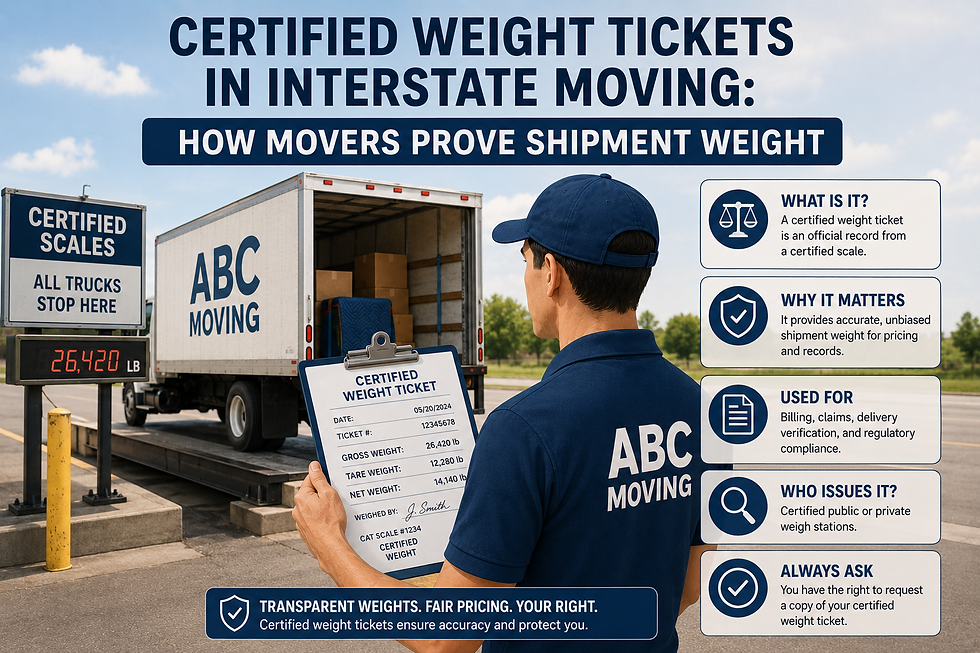
If your interstate moving price is based on weight, the number on the invoice should not be a guess.
It should be supported by weighing records.
That is where Certified Weight Tickets in Interstate Moving matter.
A certified weight ticket helps show how much your shipment actually weighed by recording the truck’s weight before and after your belongings are loaded or unloaded. In weight-based interstate moves, this is one of the main ways movers prove the shipment weight used to calculate final charges.
For customers, weight tickets are important because they help answer a very practical question:
Am I being charged for the real weight of my shipment — or just a number someone put on the invoice?
A legitimate mover should be able to explain how your shipment weight was calculated, what scale was used, what the tare and gross weights were, and whether you have the right to request a reweigh before unloading.
What Are Certified Weight Tickets in Interstate Moving?
Certified Weight Tickets in Interstate Moving are official scale records used to document the weight of a household goods shipment.
The ticket is usually created when the moving truck or trailer is weighed on a certified scale.
A weight ticket may show:
scale name and location
weighing date
vehicle identification
tare weight
gross weight
net shipment weight
customer last name
bill of lading or shipment number
weigh master signature
Strictly speaking, the federal rules refer to weight tickets and require the shipment to be weighed on a certified scale when weighing is required. That is why customers often call them “certified weight tickets.”
The important point is not the wording.
The important point is whether the shipment weight is backed by proper scale documentation.
Why Weight Tickets Matter for Interstate Moving Customers
Weight tickets matter because many interstate moving charges depend on shipment weight.
If the weight is wrong, the price may be wrong.
This is especially important for:
non-binding estimates
weight-based pricing
final freight bills
reweigh disputes
110% rule situations
claims about inaccurate charges
moves where shipment size changed before pickup
A moving estimate may start with an estimated weight. But for many non-binding interstate moves, final charges are based on the actual shipment weight and applicable tariff terms. Federal rules say a non-binding estimate is not the final guaranteed price and that final charges may be based on actual shipment weight and tariff provisions.
That is why customers should understand how weight is proven.
When Must Movers Determine the Shipment Weight?
Movers must determine shipment weight when household goods are transported under a non-binding estimate that depends on weight.
Federal rules say that when a mover transports household goods on a non-binding estimate dependent on shipment weight, the mover must determine the weight before assessing weight-based charges, and the shipment must be weighed on a certified scale.
Simple example
If your interstate estimate is non-binding and says the final price depends on shipment weight, the mover should not simply invent the final weight.
The mover should determine the shipment weight using an approved weighing method and proper tickets.
Certified Weight Tickets vs Moving Estimate
A moving estimate and a weight ticket are not the same document.
Moving estimate
The estimate shows the expected cost of the move before pickup.
It may be based on:
inventory
visual survey
estimated weight
estimated volume
requested services
accessorial charges
route and distance
Certified weight ticket
A weight ticket helps prove the actual weight used for billing.
It may show:
truck or trailer weight before loading
truck or trailer weight after loading
gross weight
tare weight
net shipment weight
The estimate helps you understand the expected price.
The weight ticket helps support the actual weight used in the final calculation.
Gross Weight, Tare Weight and Net Weight Explained
Weight tickets can look confusing until you understand three terms.
Tare weight
Tare weight is the weight of the truck or trailer without your shipment loaded.
Depending on the weighing method, this may be measured before loading at origin or after unloading at destination.
Gross weight
Gross weight is the weight of the truck or trailer with your shipment loaded.
Net weight
Net weight is the weight of your shipment.
The basic formula is:
Gross weight minus tare weight equals net shipment weight.
For example:
Gross weight: 28,000 pounds
Tare weight: 21,500 pounds
Net shipment weight: 6,500 pounds
In this example, your shipment weight would be 6,500 pounds.
How Movers Weigh an Interstate Shipment
Federal rules allow movers to determine shipment weight using two main methods: origin weighing or destination weighing, also called back weighing.
Origin weighing
With origin weighing, the truck is weighed before loading your shipment.
That first weight is the tare weight.
After your shipment is loaded, the truck is weighed again.
That second weight is the gross weight.
The difference is your net shipment weight.
Destination weighing or back weighing
With destination weighing, the truck is weighed at the destination while your shipment is still loaded.
That is the gross weight.
After delivery and unloading, the truck is weighed again.
That is the tare weight.
The difference is your net shipment weight.
Both methods can be legitimate when done properly.
The key is that the weight must be documented correctly.
What Must Be on a Weight Ticket?
Federal rules require weight tickets to include specific information when weighing is required.
Each weight ticket must include:
complete name and location of the scale
date of each weighing
identification of weight entries as tare, gross or net
company or carrier identification of the vehicle
customer last name as it appears on the bill of lading
carrier shipment registration or bill of lading number
The weigh master must sign the weight ticket, and the mover must retain the original ticket in the shipment file. Freight bills presented to the customer must include true copies of the weight tickets when charges depend on shipment weight.
Why this checklist matters
If a ticket is missing the scale location, date, vehicle ID, customer name, bill of lading number, or weight type, it may be harder for the customer to understand or verify the shipment weight.
A proper ticket should connect the weight to your actual shipment.
Can One Weight Ticket Show Both Weighings?
Sometimes, yes.
Federal rules allow one weight ticket to record both weighings if both weighings are performed on the same scale.
That can happen when the truck is weighed empty and loaded at the same scale location.
But customers should still check that both weights are clearly shown and labeled.
What to look for
Look for:
tare weight
gross weight
net weight
same scale location
weighing dates
vehicle identification
shipment or bill of lading number
If the numbers are unclear, ask the mover to explain them before paying the final bill.
Why Certified Scales Matter
A certified scale matters because it is inspected and approved for accuracy by the proper government inspection or licensing agency.
FMCSA guidance warns customers that movers may ask them to waive the right to have a shipment weighed on a certified scale and use a non-certified onboard trailer scale instead. FMCSA advises customers to demand their right to use a certified scale because non-certified scales are not inspected and approved for accuracy in the same way.
Customer takeaway
If your charges depend on shipment weight, do not casually agree to a non-certified weighing method.
Ask:
Is this a certified scale?
Where is the scale located?
Will I receive copies of the tickets?
Can I observe the weighing?
Can I request a reweigh if needed?
The weight affects the price, so the weighing method matters.
Do Customers Have the Right to Observe the Weighing?
Yes.
Federal rules say the mover must give the individual shipper or another person responsible for paying freight charges the right to observe all weighings. The mover must tell that person where and when each weighing will occur and give a reasonable opportunity to be present.
What this means in practice
You may not always want to drive to the scale.
But the right exists for a reason.
If you are concerned about shipment weight, ask the mover before pickup:
Where will the truck be weighed?
When will the weighing happen?
Can I observe it?
Who should I contact for the scale time?
Will I get copies of the tickets?
If the mover avoids the question, that is a warning sign.
Can Customers Waive the Right to Observe Weighing?
Yes, but there are details.
If a customer does not choose to observe a weighing, that right may be treated as waived.
For reweighing, federal rules say the customer must waive the right to observe in writing if they choose not to observe the reweigh. The waiver may be sent by fax, email, overnight courier, or certified mail.
Important point
Waiving the right to observe does not remove all of your other rights.
It only means you chose not to be present for that weighing or reweighing.
Still, if you are worried about an inflated weight, observing or requesting documentation can help.
What Is a Reweigh?
A reweigh is a second weighing requested when the customer questions the original shipment weight.
This can be very important when the final charges are much higher than expected.
Federal rules say that after the mover informs the customer of the billing weight and total charges, and before unloading begins for a shipment weighed at origin, the customer may demand a reweigh. The mover must base the freight bill charges on the reweigh weight.
Simple example
Original billed shipment weight: 8,000 pounds
Customer requests reweigh before unloading.
Reweigh result: 7,300 pounds
If the rules apply, the mover should base freight bill charges on the reweigh weight.
That is why asking before unloading matters.
When Should You Request a Reweigh?
A reweigh may make sense if the billed weight seems much higher than expected.
Situations where a reweigh may be worth asking about
Consider asking if:
the final weight is far above the estimate
your shipment size did not change
the mover cannot explain the weight increase
the ticket is missing or unclear
the final charges are much higher than expected
the inventory does not seem to match the billed weight
you suspect another shipment was included incorrectly
the mover refuses to provide copies of weight tickets
Do not wait until everything is unloaded.
Ask before unloading begins.
Do Movers Charge for a Reweigh?
FMCSA guidance says the mover is prohibited from charging the customer for a reweigh. If the reweigh weight is different from the origin weight, the mover must recompute charges based on the reweigh weight.
Customer takeaway
If you ask for a reweigh, ask the mover to confirm:
there is no reweigh charge
when and where the reweigh will happen
whether you can observe it
how the final charges will be recalculated
when you will receive the updated weight ticket
Get the answer in writing when possible.
What If Your Move Is Based on Cubic Feet?
Some estimates may show shipment volume, often in cubic feet.
This can confuse customers because volume may later be converted to weight for pricing.
Federal rules say that if a mover provides an estimate by volume and converts the volume to weight, the mover must provide a written explanation of the volume-to-weight conversion formula. The rules also require that final charges be based on actual weight and services subject to the 110% rule at delivery when volume is later converted to weight-based rates.
What to ask
If your estimate is based on cubic feet, ask:
Is this a volume-based estimate?
Will it convert to weight?
What formula is used?
Is the formula in writing?
Will final charges be based on actual certified weight?
Will I receive weight tickets?
Does the 110% rule apply at delivery?
Do not accept vague explanations like:
“We just convert it later.”
You need the formula in writing.
Certified Weight Tickets and the 110% Rule
Weight tickets and the 110% rule often connect in non-binding estimate disputes.
A non-binding estimate can lead to a higher final bill if the actual weight is higher than estimated.
But the 110% rule may limit what the mover can demand at delivery before releasing the shipment.
Weight tickets help show whether the actual weight increase is supported by scale documentation.
What customers should compare
Compare:
original non-binding estimate
estimated shipment weight
actual net shipment weight
weight ticket copies
delivery invoice
110% calculation
bill of lading
accessorial charges
If the mover says your move costs more because it weighed more, the ticket should help prove that.
A higher certified shipment weight can increase the final bill under a non-binding estimate, but it does not automatically mean the mover may demand the entire increased balance before releasing your belongings. Customers should compare the documented weight, original estimate, delivery invoice, and the federal payment limit that may apply. For a detailed explanation, read:
Certified Weight Tickets and Minimum Weight Charges
Some movers have minimum weight charges.
FMCSA guidance explains that many movers have a minimum weight charge, often for a shipment of at least 3,000 pounds, and that if the mover does not advise the customer of the minimum charges and the shipment is under the minimum weight, final charges must be based on actual weight rather than the minimum.
What to check
Ask:
Is there a minimum weight charge?
What is the minimum?
Is it shown on the estimate?
What happens if my shipment weighs less?
Will the actual weight still be documented?
Will I receive weight tickets?
Minimum charges should not be a surprise at delivery.
What If the Mover Does Not Provide Weight Tickets?
If final charges depend on shipment weight, the mover should provide true copies of the weight tickets with the freight bill.
Federal rules say freight bills presented to customers must include true copies of all weight tickets used to determine the shipment weight when the charges depend on the weight transported.
What to do
Ask the mover:
Please provide copies of all weight tickets.
Which ticket shows the tare weight?
Which ticket shows the gross weight?
What is the net shipment weight?
Which certified scale was used?
What bill of lading number appears on the ticket?
Can you explain the calculation in writing?
If the mover refuses, document the refusal.
Red Flags With Shipment Weight
Be careful if the mover:
gives a weight-based final bill but no weight tickets
uses vague “estimated weight” language at final billing
cannot explain gross, tare and net weight
refuses to tell you where the truck was weighed
says you cannot observe the weighing
refuses a reweigh request before unloading
uses a non-certified scale without clear explanation
gives tickets that do not match your bill of lading
combines shipments without clear documentation
cannot explain a large weight increase
pressures you to pay before showing the tickets
A professional mover should be able to explain the weight calculation clearly.
How to Read a Weight Ticket Line by Line
When you receive a weight ticket, do not just look at the biggest number.
Check these lines
Review:
scale name and location
weighing date
truck or trailer ID
customer last name
bill of lading number
gross weight
tare weight
net weight
weigh master signature
whether the ticket is for the first or second weighing
If the customer name, bill of lading number, or truck ID does not match your move, ask questions immediately.
How Customers Can Protect Themselves
Weight disputes are easier to handle when you prepare early.
Before pickup
Ask:
Is my estimate binding or non-binding?
Is the price based on weight?
What estimated weight is listed?
Will the truck be weighed on a certified scale?
Where will the weighing happen?
Can I observe the weighing?
Will I receive true copies of the tickets?
What happens if I request a reweigh?
Before delivery
Ask:
What is the actual shipment weight?
What are the total charges?
Can I see the weight tickets?
Was the shipment weighed at origin or destination?
Can I request a reweigh before unloading?
How does the actual weight compare to the estimate?
Do not wait until after unloading to ask weight questions.
FAQ About Certified Weight Tickets in Interstate Moving
What are Certified Weight Tickets in Interstate Moving?
Certified Weight Tickets in Interstate Moving are scale records used to document the weight of a household goods shipment when the move is priced based on shipment weight.
Do movers have to weigh every interstate shipment?
Movers must determine shipment weight when transporting household goods under a non-binding estimate dependent on shipment weight. Binding estimates may work differently if the price is already fixed for listed items and services.
What is the difference between gross, tare and net weight?
Gross weight is the truck with the shipment loaded. Tare weight is the truck without the shipment. Net weight is the shipment weight calculated by subtracting tare weight from gross weight.
Can I ask for copies of the weight tickets?
Yes. When charges depend on shipment weight, freight bills presented to customers must include true copies of the weight tickets used to determine shipment weight.
Can I watch the truck being weighed?
Yes. Customers have the right to observe all weighings, and the mover must tell them where and when weighings will occur and give a reasonable opportunity to be present.
Can I request a reweigh?
Yes, under the applicable rules, after the mover informs you of the billing weight and total charges and before unloading begins for an origin-weighed shipment, you may demand a reweigh.
Final Checklist Before You Accept a Weight-Based Final Bill
Before paying a weight-based interstate moving bill, confirm:
estimate type
estimated shipment weight
actual net shipment weight
certified scale used
tare weight
gross weight
weight ticket copies
bill of lading number
vehicle identification
customer last name
weigh master signature
whether origin or destination weighing was used
whether you were offered the right to observe
whether a reweigh is needed before unloading
whether the final charge matches the documented weight
Certified Weight Tickets in Interstate Moving help prove the shipment weight behind your final moving charges. If your interstate move is billed by weight, ask how the weight was determined, request true copies of the tickets, understand gross, tare and net weight, and know your right to observe weighings or request a reweigh when the rules allow it.
Related Interstate Moving Guides
Binding vs Non-Binding Moving Estimates: What Interstate Movers Don’t Explain
Real Moving Cost vs Estimate: Why Your Quote Is Not the Final Price
Why Most Inaccurate Interstate Moving Quotes Happen (And How to Spot a Real One)
Bill of Lading for Interstate Moving: What Customers Must Check Before Signing
Author:
Written by: Arthur Brooks — Owner & Operations Manager Interstate moving, storage & claims operations expert
Just Movers / BY Logistic LLC
Dallas, TX • Miami, FL


