
Miami Interstate Movers: Cost, Building Access and Delivery Timing Explained
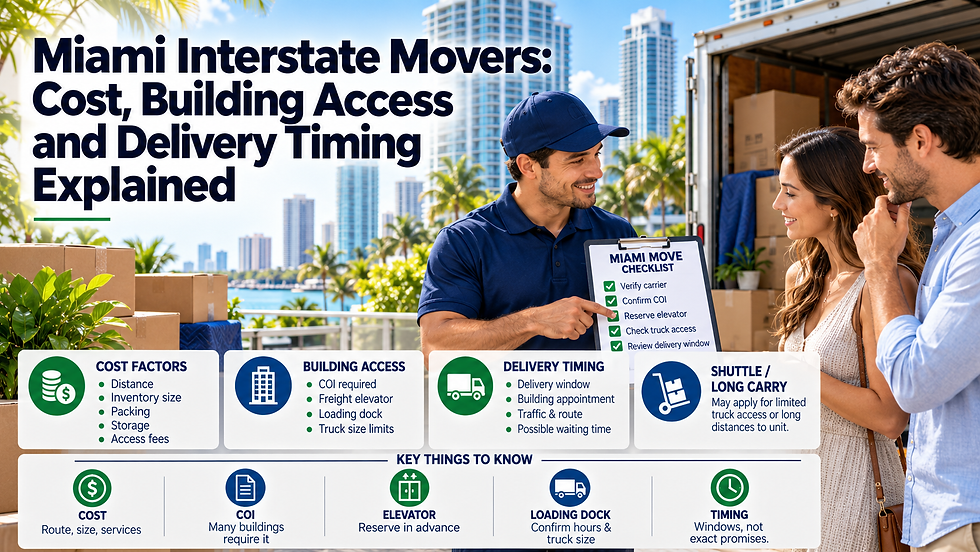
Moving to or from Miami can become complicated long before anyone lifts the first box.
The transportation distance matters, but so do the building, parking location, elevator reservation, loading zone, truck size, delivery window, insurance paperwork, and exact company responsible for your shipment.
A mover may provide a reasonable transportation quote and still be missing important information about your property.
The destination could require a Certificate of Insurance. The freight elevator may be available for only two hours. The assigned interstate truck may be too large for the loading area. The delivery crew may need to use a smaller shuttle vehicle or carry the shipment through a long service corridor.
Those details affect both price and timing.
When comparing Miami Interstate Movers, do not focus only on the number at the bottom of the estimate. You need to understand:
who will physically transport your belongings;
how the price was calculated;
which access services are included;
when the shipment is expected to arrive;
whether the delivery date is estimated or guaranteed;
what happens if the building refuses access;
how storage, waiting time, shuttle service, or redelivery will be charged.
For an interstate household-goods move, the carrier generally must complete a physical or qualifying virtual survey and provide a written estimate unless the customer properly waives the survey. The applicable federal requirements appear in 49 CFR Part 375, Subpart D.
This guide explains how Miami moving costs work, why building access can change the final bill, what delivery timing really means, and what customers should verify before booking a long-distance carrier.
Miami Interstate Movers: What to Check Before Booking
Start with six questions.
What to check | What you need in writing |
Carrier identity | Legal name, USDOT number, carrier or broker status |
Shipment price | Written estimate based on a complete inventory and requested services |
Building access | COI, elevator, loading dock, parking and truck-size requirements |
Transportation plan | Dedicated or consolidated service, transfers, storage and route assumptions |
Delivery timing | Agreed delivery date or period and any guarantee terms |
Protection and payment | Valuation selection, payment method, deposits and delivery balance |
Do not treat one unanswered question as something that can always be resolved after pickup.
Once your belongings are loaded, the moving company controls the physical shipment. Clear documents matter more at that point than verbal assurances from a salesperson.
Verify Whether You Are Hiring a Carrier or Broker
A carrier transports the shipment.
A broker arranges transportation with another company.
Both may be registered with FMCSA, but they have different responsibilities. FMCSA explains that a broker does not own the truck or assume responsibility for transporting the household goods, while the mover or carrier performs the physical transportation. Review FMCSA’s Movers vs. Brokers guide.
Ask:
Are you the actual transporting carrier?
Will your own truck and crew perform pickup?
Can another carrier be assigned?
Which company will issue the Bill of Lading?
Which carrier’s tariff is being used?
Who will collect the delivery balance?
Who will provide tracking updates?
Who is responsible for loss or damage claims?
A company can advertise itself as serving Miami without being the carrier that arrives at your property.
If a broker is involved, request the carrier’s legal name and USDOT number before loading. Confirm that the building’s COI and access approval apply to the company that will actually enter the property.
Verify the Mover Through FMCSA
Use FMCSA’s Protect Your Move resources to review the mover’s registration and consumer information. FMCSA advises customers to understand the difference between carriers and brokers, review moving documents, and verify the company before entrusting it with household goods.
Compare the official record with:
the estimate;
company website;
payment instructions;
Bill of Lading;
truck name;
COI;
customer-service email;
claims contact.
A brand name may differ from a legal company name, but the company should be able to explain the connection.
Be cautious when:
the USDOT number belongs to another business;
the salesperson refuses to identify the carrier;
the company name changes before pickup;
payment is requested by an unrelated person or entity;
the truck arrives under a name missing from your documents.
Registration does not guarantee excellent service, but a company that cannot clearly identify itself should not receive your shipment.
How Much Do Miami Interstate Movers Cost?
There is no single price for an interstate move from Miami.
The final cost depends on:
destination;
shipment weight or volume;
inventory accuracy;
packing;
storage;
building access;
shuttle service;
long carry;
stairs and elevators;
bulky items;
valuation protection;
delivery service;
moving date;
carrier availability.
Current public pricing data can provide a budgeting reference, but it is not a substitute for a written estimate based on your shipment.
Current Miami route examples
As of October 2026, current public quote data shows the following broad full-service planning ranges:
Route and estimated home size | Current full-service planning range | Typical planning timeline |
Miami to Atlanta — studio or 1 bedroom | $1,322–$3,524 | 1–6 days |
Miami to Atlanta — 2 to 3 bedrooms | $1,970–$4,720 | 1–6 days |
Miami to Atlanta — 4+ bedrooms | $3,530–$6,830 | 1–6 days |
Miami to Dallas — studio or 1 bedroom | $1,842–$4,618 | 3–8 days |
Miami to Dallas — 2 to 3 bedrooms | $2,409–$5,812 | 3–8 days |
Miami to Dallas — 4+ bedrooms | $4,368–$8,134 | 3–8 days |
Miami to New York City — studio or 1 bedroom | $1,972–$4,388 | 3–8 days |
Miami to New York City — 2 to 3 bedrooms | $2,390–$5,952 | 3–8 days |
Miami to New York City — 4+ bedrooms | $4,191–$8,063 | 3–8 days |
The route estimates come from current public pricing data for Miami-to-Atlanta moves, Miami-to-Dallas moves, and Miami-to-New York City moves. They are budgeting references rather than binding offers.
Packing, storage, shuttle service, specialty handling, access charges, and additional valuation can increase the total.
Why Two Miami Moving Quotes Can Be Very Different
Two movers may appear to quote the same route while pricing different services.
One estimate may assume:
ground-floor pickup;
easy truck parking;
no packing;
standard consolidated delivery;
no storage;
no bulky items.
Another may include:
high-rise pickup;
full packing;
loading-dock coordination;
shuttle risk;
valuation;
tighter delivery timing;
temporary storage.
The lower total is not necessarily the better price.
Before comparing totals, make sure each company is pricing the same:
inventory;
destination;
building access;
packing requirements;
storage assumptions;
valuation option;
transportation type;
delivery commitment.
An incomplete quote often becomes expensive after the crew arrives.
Get a Survey-Based Written Estimate
Federal rules generally require the interstate carrier to conduct a physical survey and provide a written estimate based on the shipment and related services unless the customer signs a proper waiver. The survey can be conducted on-site or through a qualifying virtual process. See 49 CFR § 375.401.
During the survey, show:
every room;
closets;
balcony;
garage;
storage unit;
outdoor furniture;
appliances;
artwork;
gym equipment;
piano or safe;
cartons already packed;
stairs;
elevator;
service corridor;
parking area;
loading dock.
Do not describe a complete Miami condo as:
Two bedrooms and some boxes.
The estimator needs to see the actual shipment and the access route.
Also provide information about the delivery address. If the destination is not final, ask the mover to state the assumptions used in the quote.
Binding vs Non-Binding Estimates
The estimate type affects how the final charge may change.
Binding estimate
A binding estimate establishes the charge for the goods and services listed in the agreement.
The amount may still change when the customer adds property, requests new services, or changes the move under the applicable rules.
A binding estimate should not be treated as permission to add unlimited items for the original price.
Non-binding estimate
A non-binding estimate is an approximation.
The final price may depend on:
actual shipment weight;
services actually provided;
carrier tariff;
packing;
storage;
accessorial services;
authorized changes.
A non-binding estimate should still be reasonably accurate.
A carrier should not give an unrealistically low number simply to obtain the booking and explain the real price after loading.
The federal requirements for estimates appear in 49 CFR Part 375, Subpart D.
Miami Building Access Can Change the Final Price
High-rise and managed-building access can add more work than customers expect.
A property may require:
Certificate of Insurance;
additional-insured entities;
freight-elevator reservation;
loading-dock appointment;
move-in or move-out deposit;
security registration;
approved moving hours;
floor and wall protection;
truck-size approval;
service-entrance use;
advance notice.
These requirements are generally building policies rather than one universal Miami rule.
Ask management for written instructions and send them to the mover before finalizing the estimate.
The mover should know:
exact building address;
unit number;
floor;
elevator dimensions;
loading area;
permitted vehicle size;
reservation time;
distance to the apartment.
A Certificate of Insurance approval does not automatically reserve the elevator or loading dock.
Each step may require separate confirmation.
Miami high-rise moves require coordination between the carrier and the building before the truck arrives. A valid COI does not necessarily reserve the freight elevator, and an elevator reservation does not guarantee that the assigned interstate truck can use the loading dock. Customers should confirm insurance approval, building hours, vehicle restrictions, service entrances and elevator access as separate parts of the delivery plan. For a complete high-rise planning checklist, read Moving Into a High-Rise Apartment: Elevator, COI and Loading Dock Checklist.
Certificate of Insurance for a Miami Move
A building may require proof that the moving company carries specified commercial insurance.
The building may request:
general liability;
automobile liability;
workers’ compensation;
umbrella coverage;
certificate-holder information;
additional-insured endorsements;
building address;
unit number;
move date.
The customer should not edit the COI.
Send the building’s exact requirements to the mover, and let the mover’s insurance professional prepare the certificate.
Before submitting it, confirm that the named insured is the company performing the work.
If a broker’s certificate is approved but another carrier arrives with the truck and crew, management may refuse access.
Ask the building to confirm approval in writing.
Freight Elevator and Loading Dock Rules
Reserve the freight elevator and loading dock separately unless the building confirms that one reservation includes both.
Ask:
What moving hours are allowed?
Is the elevator reservation exclusive?
Does setup time count?
How long is the appointment?
Is an elevator operator required?
Who installs elevator pads?
What truck sizes fit the dock?
Is the dock height restricted?
Is security registration required?
What happens if the truck arrives late?
A standard interstate delivery window may not align perfectly with a two-hour building appointment.
Discuss that conflict with both the mover and the building before pickup.
City of Miami Loading Zones
The City of Miami uses Smart Loading Zones in selected high-traffic areas.
The Miami Parking Authority states that commercial drivers must register through CurbPass, obtain approval for a qualifying commercial vehicle, maintain a valid payment method, and use the zones for active loading or unloading. The current maximum stay is 30 minutes, and vehicles that overstay, double park, or block traffic may be cited. See the Miami Parking Authority Smart Loading Zones Program.
A 30-minute curbside zone is not a substitute for a proper high-rise loading plan.
A full household delivery may require:
private loading dock;
reserved commercial space;
building service area;
smaller delivery vehicle;
shuttle service;
multiple trips.
Ask the carrier who is responsible for confirming legal truck parking.
Do not assume that placing cones in the street creates a valid reservation.
Miami Beach Has Separate Freight Loading Rules
Miami Beach is a separate municipality with its own freight-loading and alley-loading program.
The city identifies Commercial Loading Zones, Freight Loading Zones, and Alley Loading locations. Certain freight and alley areas require an FLZ or AL permit, and violations may result in citations or towing. Review the City of Miami Beach Freight Loading Parking Permit Program.
Do not treat “Miami” and “Miami Beach” as the same parking jurisdiction.
A property in:
City of Miami;
Miami Beach;
Coral Gables;
Brickell;
Sunny Isles Beach;
Aventura;
unincorporated Miami-Dade;
may have different municipal, property, and parking requirements.
Ask for the exact jurisdiction and building instructions.
Residential Truck Access in Miami-Dade County
Miami-Dade County restricts storage and parking of larger commercial vehicles in residential districts, while allowing temporary parking in certain circumstances for active loading, unloading, or commercial service.
The county’s commercial-vehicle parking guidance explains that Category 3 vehicles include vehicles exceeding specified dimensions, semi-tractors, and trailers, and addresses temporary loading and unloading activity.
This does not mean every residential street can accommodate an interstate tractor-trailer.
The driver must also consider:
posted signs;
road width;
turning radius;
overhead clearance;
private-property rules;
HOA restrictions;
traffic obstruction;
safe ramp placement.
A large truck may need to remain at another location while a smaller vehicle completes delivery.
Shuttle Service in Miami
A shuttle service may be required when the road-haul truck cannot reach the residence or loading area.
The mover transfers the household goods between the large interstate vehicle and a smaller truck.
Possible Miami-area reasons include:
narrow streets;
low garage clearance;
tight loading dock;
restricted causeway or property entrance;
prohibited tractor-trailer access;
limited turning space;
no legal parking near the building;
gated-community restrictions.
Shuttle service may add:
another truck;
extra labor;
additional handling;
more delivery time;
possible warehouse or parking coordination.
Ask whether the shuttle charge is based on:
shipment weight;
volume;
labor;
truck use;
mileage;
minimum fee.
The service and rate should be explained in the mover’s estimate or applicable tariff terms.
Long Carry Fees in Miami Buildings
A long carry fee may apply when the truck cannot park within the carrier’s standard included distance from the entrance.
In a Miami high-rise, the route may include:
curb to loading entrance;
loading entrance to dock;
dock to service elevator;
elevator to hallway;
hallway to apartment.
Ask:
How many feet are included?
Where does measurement begin?
Does the interior corridor count?
How is the additional distance priced?
Can long carry apply at both pickup and delivery?
Can the mover evaluate it before booking?
Do not assume that an elevator eliminates a long carry.
A building can have excellent elevator access but a very long distance between legal truck parking and the elevator.
Elevator, Stairs and Waiting-Time Charges
High-rise delivery may create separate charges for:
freight-elevator handling;
stair carry;
waiting time;
extra labor;
additional stop;
after-hours service;
redelivery.
Ask the mover to identify each charge separately.
For example:
Waiting time may apply when the crew is present but cannot begin because security has not approved the carrier.
Stair carry may apply when the freight elevator is broken or unavailable and the crew agrees that stair delivery is safe.
Redelivery may apply when the truck must leave and return because the building refuses access.
Do not assume that every access problem is included in the base transportation charge.
Truck Size and Garage Clearance
Many Miami buildings use loading docks or garages with height and length restrictions.
Before delivery, obtain:
maximum truck height;
maximum vehicle length;
dock clearance;
garage clearance;
turn-radius information;
ramp restrictions;
loading-door dimensions.
Send the information to dispatch.
Do not send only the property address and assume the carrier will discover the restrictions on arrival.
Ask whether the shipment is expected to arrive in:
tractor-trailer;
straight truck;
box truck;
shuttle vehicle;
local delivery truck.
Vehicle type can change during an interstate move. Confirm how the mover will respond if the assigned truck cannot enter.
Miami Traffic and Delivery Scheduling
Miami traffic can affect arrival estimates, but it does not eliminate the carrier’s written delivery obligations.
The carrier should distinguish between:
broad interstate delivery window;
driver’s estimated arrival;
confirmed building appointment;
guaranteed delivery date.
A driver may give a morning estimate and still encounter congestion, inspections, earlier deliveries, or loading complications.
Do not reserve the shortest possible elevator appointment based only on a rough arrival time.
Ask:
How much notice will the driver provide?
Will dispatch narrow the delivery window?
Can the building appointment be moved?
What happens if the crew arrives after the approved hours?
Is waiting time charged?
Is weekend delivery available?
The carrier must tender an interstate shipment on the agreed delivery date or within the period stated on the Bill of Lading unless the customer requests or agrees to a different arrangement. See 49 CFR § 375.603.
First Available Delivery Date vs Delivery Window
These terms are not interchangeable.
First available delivery date
This is the earliest date you can receive the shipment.
It is not automatically the day the truck will arrive.
Delivery window
This is the date or period during which the carrier agrees to tender delivery.
Guaranteed delivery
Guaranteed service involves a stronger written commitment and should state any compensation or penalty terms that apply if the carrier misses the commitment.
Example:
First available delivery date: June 10 Delivery window: June 10–17 Driver estimate: June 13 Building appointment: June 13, 10:00 a.m.–2:00 p.m.
Only the delivery terms written into the moving documents define the carrier’s contractual timing obligation.
Standard, Expedited and Dedicated Delivery
These services solve different problems.
Standard consolidated delivery
The shipment may share truck capacity with other customers.
This usually offers a lower cost but may involve:
additional stops;
broader delivery window;
route coordination;
warehouse or terminal activity.
Expedited service
The shipment receives a faster or set-date transportation commitment for an additional charge.
Expedited does not automatically mean the shipment is alone on the truck.
Dedicated truck or exclusive use
The customer purchases exclusive vehicle space under the agreement.
This can provide fewer unrelated shipment interactions but does not automatically guarantee one delivery date.
Ask the mover which service is included and where it appears in the written documents.
What If the Miami Building Is Not Ready?
The building may be unavailable because:
COI was rejected;
elevator reservation was missed;
loading dock is occupied;
move-in deposit is unpaid;
unit is not ready;
security has no authorization;
assigned carrier differs from the approved company;
truck exceeds building limits.
Possible outcomes include:
waiting time;
attempted delivery;
shuttle arrangement;
storage-in-transit;
warehouse handling;
redelivery;
revised delivery window.
Ask for every new service and charge in writing.
Do not rely on:
We will just keep the truck overnight.
The mover should explain where the shipment will go, who is responsible for it, and how the new delivery will be priced.
Storage-in-Transit for a Miami Move
Storage-in-transit, or SIT, is temporary storage connected to the interstate transportation service.
It may be necessary when:
the Miami address is not ready;
building access is denied;
closing is delayed;
the customer requests later delivery;
only part of the shipment can be accepted.
Ask:
Where is the warehouse?
Is it climate-controlled?
How is storage priced?
Is warehouse handling separate?
What does final delivery cost?
Is customer access permitted?
How much notice is required?
Does valuation continue during storage?
When does SIT convert to permanent storage?
A low monthly storage rate can be misleading if handling and redelivery are expensive.
Packing and Specialty Items
Packing services may include:
full packing;
kitchen packing;
fragile-item packing;
wardrobes;
television cartons;
mirror cartons;
custom crating;
unpacking.
Identify specialty items separately:
piano;
safe;
treadmill;
exercise equipment;
marble table;
large artwork;
oversized sectional;
sleeper sofa;
commercial appliance.
The mover may need exact measurements, weight, model information, photographs, disassembly instructions, and a specialty crew.
A large item may fit inside the apartment but not inside the elevator.
Measure before pickup.
Valuation Protection Is Not the Same as Insurance
Interstate movers must offer two liability options:
Full Value Protection;
Released Value Protection.
Under Released Value, the carrier’s liability is generally limited to $0.60 per pound per article. A 25-pound television would therefore have a liability limit of only $15 under that option.
FMCSA explains the two choices in its Liability & Protection guidance.
Ask for written details about:
deductible;
declared shipment value;
extraordinary-value articles;
owner-packed boxes;
storage;
repair options;
replacement terms.
A building COI does not provide Full Value Protection for your household goods.
These are separate issues.
Review the Bill of Lading Before Loading
The Bill of Lading is the transportation contract.
Federal rules require it to identify important terms including:
mover’s legal or trade name;
participating carriers when known;
payment method;
shipment identification;
pickup and delivery date or period;
special and accessorial services;
valuation;
estimate and inventory attachments.
The detailed requirements appear in 49 CFR § 375.505.
Before loading, compare the Bill of Lading with:
estimate;
inventory;
COI carrier name;
delivery address;
delivery period;
payment terms;
storage plan;
access services.
Do not sign a blank or incomplete document.
Understand Payment Before Delivery
Federal rules require the mover to specify the form of payment in the estimate and repeat it in the Bill of Lading. The mover must honor that payment method unless the customer agrees to a change in writing. Review 49 CFR Part 375 payment requirements.
Before delivery, confirm:
deposit paid;
pickup payment;
credits;
balance due;
accepted method;
card authorization;
certified-check payee;
additional charges;
receipt procedure.
Do not wait until the driver is outside the building to discover that the carrier expects a different form of payment.
Miami Interstate Movers Red Flags
Be cautious when a company:
refuses to identify itself as carrier or broker;
gives a quote without a survey;
will not provide a USDOT number;
asks for a large unexplained deposit;
ignores building access;
says every Miami building works the same way;
promises an exact delivery date only verbally;
cannot explain shuttle or long-carry charges;
refuses to identify storage location;
tells you valuation is “full insurance” without written terms;
asks you to sign blank documents;
changes the company name at pickup;
demands an unexpected payment method;
pressures you to book immediately.
One issue may have an innocent explanation.
Several together should cause you to pause and verify the company before proceeding.
Questions to Ask Miami Interstate Movers
Ask each moving company:
Are you the carrier or broker?
What is your legal name and USDOT number?
Will your own truck and crew perform pickup?
Can another carrier be assigned?
Will you conduct a visual survey?
Is the estimate binding or non-binding?
What inventory and services are included?
Is the shipment dedicated or consolidated?
What is the delivery date or period?
Is any delivery promise guaranteed?
Can the shipment enter a warehouse?
How is storage priced?
How is shuttle service priced?
How is long carry measured?
Who handles the COI?
Can your truck access my building?
What happens if the elevator or dock is unavailable?
Which valuation option is included?
What payment method is required?
Who will help me after pickup?
The mover’s written answers are more useful than a polished sales call.
Illustrative Miami Moving Scenarios
Miami high-rise to Atlanta apartment
The shipment includes a one-bedroom condo.
The Miami building requires a COI, freight elevator, loading dock, and morning appointment. The Atlanta property has easy access.
The transportation price may fall within a current public planning range, but building coordination, packing, and waiting time can increase the total.
Miami house to Dallas suburb
A three-bedroom household has easy Florida pickup access and a Texas destination with a wide driveway.
The route is longer, but access is relatively simple.
Shipment size, packing, transportation arrangement, and delivery timing are likely to affect the cost more than building fees.
Miami Beach condo to New York City high-rise
Both properties have restricted truck access.
The shipment may require:
Miami Beach freight-loading coordination;
COI approval;
freight elevators;
loading appointments;
shuttle service;
long carry;
tighter delivery planning.
The same amount of furniture can cost much more to service under this access plan than between two ground-floor homes.
These examples are illustrative, not quotes.
FAQ About Miami Interstate Movers
How much do Miami interstate movers cost?
The cost depends on destination, shipment size, packing, access, storage and service type. Current public route examples show full-service ranges from approximately $1,322–$6,830 for Miami to Atlanta, $1,842–$8,134 for Miami to Dallas, and $1,972–$8,063 for Miami to New York City, depending on home size. These figures are planning references rather than binding quotes.
How long does an interstate move from Miami take?
It depends on the destination and transportation arrangement. Current public data suggests approximately 1–6 days for Miami to Atlanta and 3–8 days for Miami to Dallas or New York City. Your written delivery period controls.
Do Miami buildings require a COI?
Some managed apartments, condos and high-rises do. Requirements vary by property. Ask management for the exact certificate holder, additional insured entities, coverage limits, endorsements and submission deadline.
Do I need to reserve a freight elevator?
Many managed buildings require an elevator reservation, but it is a property rule rather than a universal Miami requirement. Confirm the reservation separately from COI approval.
Can a large moving truck park anywhere while unloading?
No. The carrier must follow building, municipal and parking rules. City of Miami Smart Loading Zones have specific registration, payment and time-limit requirements, while Miami Beach operates a separate freight-loading permit program.
What if the main truck cannot reach the property?
The mover may need a smaller shuttle vehicle. Ask how the charge is calculated and whether the access problem was evaluated during the estimate.
Does dedicated service guarantee the delivery date?
No. Exclusive vehicle use and guaranteed delivery are different services. Ask for the exact delivery commitment and compensation terms in writing.
What if the building refuses access?
The shipment may require waiting, storage, redelivery or another access arrangement. Ask for the new terms and charges in writing before authorizing additional service.
Final Miami Interstate Moving Checklist
Verify the carrier’s legal name, USDOT number and authority.
Confirm carrier or broker status.
Complete a visual survey and accurate inventory.
Review binding or non-binding estimate terms.
Compare equivalent services between movers.
Obtain building COI requirements.
Confirm the actual carrier can satisfy the COI.
Reserve freight elevator and loading dock separately.
Confirm approved moving hours.
Verify truck-size and garage-clearance limits.
Confirm legal truck parking or loading-zone access.
Review shuttle and long-carry risk.
Confirm stairs, waiting-time and redelivery charges.
Understand standard, expedited, dedicated and guaranteed service.
Review delivery date or period.
Confirm storage-in-transit terms.
Select valuation protection.
Review the Bill of Lading before loading.
Confirm the delivery payment method and balance.
Keep all approvals, documents and contact information with you.
Choosing Miami Interstate Movers should involve more than finding the lowest transportation quote.
The right carrier should understand the shipment, the building, the truck-access plan, the delivery timing, and the documents needed to complete the move.
Before booking, make sure the written estimate reflects the real inventory and both properties. Confirm that the building expects the correct carrier. Understand how the shipment will travel and when it should arrive.
A successful Miami interstate move begins before the truck enters the city—with the carrier verified, the access plan approved, the elevator ready, and every important promise written down.
Related Interstate Moving Guides
This guide provides general consumer information. Current market-price examples are budgeting references, not binding moving quotes.
Author:
Written by: Arthur Brooks — Owner & Operations Manager
Interstate moving, storage & claims operations expert
Just Movers / BY Logistic LLC
Dallas, TX • Miami, FL


